

Table of Contents
- What to Do Immediately After a Bad Haircut
- How to Talk to Your Stylist About a Bad Haircut
- How to Style Uneven Layers While Your Hair Grows Out
- Camouflaging Choppy Cuts with Hair Accessories and Styling Products
- Corrective Haircut Services: When to See a Different Professional
- Fixing a Bad Haircut for Curly vs. Straight Hair Textures
- Frequently Asked Questions
Last Updated: September 19, 2026
What to Do Immediately After a Bad Haircut
The first thing to do when you need to fix a bad haircut is nothing drastic. Most people want to run home and "fix" the problem themselves, and that instinct usually makes things worse.
Here's what to do in the first 24 hours:
- Take a breath and avoid grabbing scissors or clippers
- Take photos from the front, side, and back in natural light
- Wash and style your hair the way you normally would
- Write down exactly what bothers you (length, layers, blending)
- Call the salon and ask about their correction or adjustment policy
How to Talk to Your Stylist About a Bad Haircut
Here's a simple script you can use:
"Hi, I got my hair cut on [date] and I'd like to come back in. The layers on one side are sitting uneven and the ends feel choppy. Can I book a correction with [stylist's name]?"
A few things to keep in mind:
- Bring your original reference photos to the follow-up visit
- Ask what the salon's policy is on adjustments
- Request the same stylist if you want them to learn your hair
- Ask for a senior stylist if you've lost confidence in the original one
How to Style Uneven Layers While Your Hair Grows Out
Uneven layers are the most common complaint after a bad cut, and styling can hide most of the problem until your hair grows back. The trick is to add texture and movement so the eye doesn't land on the uneven line. The difference between a fix that works and one that doesn't is matching the product to your hair type and understanding why it works.
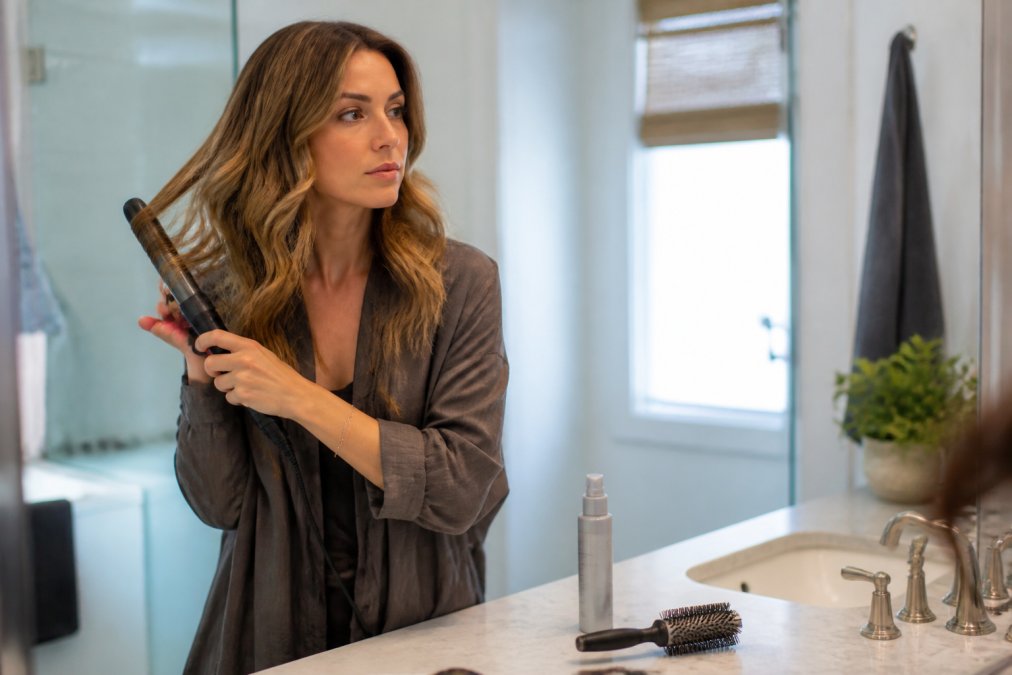
The mechanism: why texture hides uneven lines
A hard, straight line of hair reflects light in one continuous band, which is why uneven layers are so visible on smooth, blown-out hair. Texture breaks that reflection into many small highlights, so the eye reads the shape as intentional rather than crooked. Every technique below works by disrupting that single reflective line.
Product picks by hair type
Generic advice fails here because a product that adds grit to fine hair will flatten thick hair, and a cream that defines curls will collapse straight hair. Match the product to the texture:
- Fine, straight hair: a lightweight sea-salt spray (look for magnesium sulfate high on the ingredient list) or a dry texturizing spray applied at the mid-lengths. Skip heavy pomades, they weigh fine hair down and expose the uneven line.
- Medium to thick straight hair: a matte clay or fiber pomade, warmed between the palms and worked through the ends. Matte formulas add grip without shine, which is what breaks up a blunt line.
- Wavy hair: a lightweight curl cream plus a light-hold gel, scrunched into damp hair and air-dried or diffused. The wave pattern itself does the camouflaging work.
- Curly hair: a leave-in conditioner followed by a defining cream or gel, applied to soaking-wet hair and left alone to dry. Do not touch curls while they dry, frizz exposes uneven lines faster than anything else.
Styling techniques that actually blend the line
- Blow-dry with a round brush to blend short and long pieces into one shape, but point the nozzle down the hair shaft, not across it, or you'll create flyaways that highlight the uneven edge.
- Curl away from your face so the shorter layers tuck under the longer ones. Curling toward the face pushes short pieces forward and makes them more obvious.
- Try a messy, piecey look with pomade on straight hair to break up hard lines.
- Shift your part. Moving a part half an inch to one side relocates where every layer falls, which can hide an uneven section without any product at all.
- Add a slight wave with a curling iron to soften any blunt edges.
A visual way to check your work
Stand in front of a mirror with a hand mirror behind you so you can see the back of your head, and photograph the result from the front, side, and back in natural light. Compare the photos side by side. If the uneven line is still visible in the photo, it will be visible in person, add a little more texture and re-check.
How long until styling is no longer necessary
Hair grows roughly half an inch per month on average. If your uneven section is about an inch shorter than the surrounding hair, expect roughly two months before the difference stops being noticeable without styling. Until then, the techniques above are a bridge, not a permanent fix.
Camouflaging Choppy Cuts with Hair Accessories and Styling Products
Hair accessories are the fastest way to hide a bad cut while it grows. A choppy cut is one with visible hard lines or disconnected pieces, and accessories break up those lines instantly. The mistake most people make is grabbing the first headband they find, placement and proportion matter more than the accessory itself.
Accessories, ranked by what they hide best
- Headbands to cover uneven bangs or a short front section. A wide fabric headband sits lower on the forehead and hides more than a thin plastic one.
- Claw clips to pull back the top half and hide uneven layers. A medium claw clip placed at the crown creates volume that distracts from a choppy perimeter.
- Bobby pins to tuck short pieces behind your ears. Match the pin to your hair color so it disappears rather than drawing attention.
- Silk scarves for a polished look that covers the whole crown. A scarf tied at the nape hides the most surface area of any single accessory.
- Wide barrettes to add interest on one side. Place the barrette on the side with the better cut so the eye is drawn there.
Placement rules that make accessories work
- Place the accessory at the widest or most uneven point, not above it. An accessory sitting above the problem draws the eye straight to it.
- Match the accessory width to the problem size. A thin clip can't hide a two-inch choppy section; a wide barrette can.
- Use asymmetry deliberately. Pinning one side back and leaving the other down creates a diagonal line that the eye follows instead of the horizontal uneven line.
- Avoid tight, slicked-back styles if your cut is choppy at the perimeter, pulling hair flat exposes every hard edge.
Styling products that finish the job
A good styling cream, sea salt spray, or light pomade can smooth split ends and give the cut a finished look. Match the formula to your goal:
- To smooth and seal: a lightweight styling cream or a few drops of a silicone-free serum, applied to the ends only.
- To add grip and texture: a sea salt spray on damp hair before blow-drying, or a dry texturizing spray on finished hair.
- To add shine and control flyaways: a light pomade or a drop of argan oil, warmed between the palms first.
When accessories stop being enough
Accessories are a bridge, not a solution. If you find yourself wearing a headband or scarf every single day for more than a few weeks, it's worth booking a corrective consultation, a stylist can often blend the choppy section in a single appointment, which is faster than waiting for it to grow out.
Corrective Haircut Services: When to See a Different Professional
Corrective haircut services are appointments specifically designed to fix a bad haircut from another stylist. You should consider one if the cut is more than a trim-level mistake, if the original stylist can't fix it, or if you've simply lost trust in them.
Signs it's time to see someone new:
- The original stylist won't acknowledge the problem
- The salon has no adjustment or correction policy
- Two weeks have passed and the cut still looks wrong
- Your layers are so uneven that styling can't hide them
- You're considering at-home fixes out of frustration
Fixing a Bad Haircut for Curly vs. Straight Hair Textures
Curly and straight hair need different fixes because they behave differently. Curly hair hides uneven lines better, but it also shrinks and springs up, which can make a bad cut look worse. Straight hair shows every hard line, but it also grows out more predictably.
For curly hair:
- Get a dry cut from a stylist who works with curls
- Use a leave-in conditioner and curl cream to define shape
- Avoid brushing dry curls, which causes frizz
- Let curls air-dry to see the real shape
For straight hair:
- Blow-dry with a round brush to smooth hard edges
- Ask for point-cutting to soften blunt lines
- Use a light pomade to add movement
- Try a center or side part to shift where layers fall
| Hair Type | Best Fix | What to Avoid | Time to Grow Out |
|---|---|---|---|
| Curly | Dry cut, curl cream, air-dry | Brushing dry curls | 3-6 months |
| Wavy | Texturizing spray, round brush | Heavy pomade | 2-4 months |
| Straight | Point-cut, blow-dry, pomade | Kitchen-scissor trims | 4-8 weeks |
| Fine/thinning | Custom topper, scalp therapy | Harsh styling tools | Varies |
Frequently Asked Questions
What should I do immediately after realizing I have a bad haircut?
Don't panic or grab scissors. Wash and style your hair as usual to see how it behaves. Take photos from multiple angles. If the cut is uneven or too short, resist the urge to fix it yourself. Instead, contact the salon within 48 hours to request a corrective appointment. Many salons, including Pileggi on the Square, offer adjustments if you speak up promptly and politely.
How long does it take for a bad haircut to grow out?
Hair grows about half an inch per month on average. A noticeable difference in length takes two to three months, but blending uneven layers or softening a choppy cut often requires three to six months. Regular trims every six to eight weeks help maintain shape while growing out. For faster results, focus on scalp health and a protein-rich diet.
How do I talk to my stylist about a bad haircut without being rude?
Schedule a consultation and use 'I' statements. For example, 'I feel the layers on the left are shorter than the right' instead of 'You messed up.' Bring reference photos of what you wanted. Ask if they offer corrective haircut services. A reputable stylist will listen and may adjust the cut at no extra charge. If they dismiss your concerns, consider a different professional.
What are the best hair accessories to hide a bad haircut?
Headbands, wide fabric bands, and claw clips are effective for masking uneven layers or a choppy fringe. For short cuts, try a beanie or scarf. Texturizing spray and pomade can add definition to hide blunt lines. For curly hair, a diffuser and leave-in conditioner help blend uneven sections. Pileggi on the Square stylists often recommend accessories that match your hair color for a seamless look.
0 comments